ed from Taha Neyestani on Vimeo.

Robert D'Arista, Monotype
Sunday, January 31, 2016

Sunday, January 17, 2016
Richard Diebenkorn's Sketchbooks

Stanford University has launched an interactive website containing all of the sketchbooks of Richard Diebenkorn, 1922-1993. Click the drawing above to visit the site.
Monday, January 12, 2015
Searching: The Art of the Gesture
Peruse the yellow pages for medical doctors and you quickly find a host of experts on particular parts of the human body. There are doctors for the feet, doctors for the heart, specialists who focus on the brain, others who study the nervous system. There are blood doctors, bone doctors, skin doctors, eye doctors, and so on. When we begin to draw the human figure we often find ourselves like the above specialists, scrutinizing the parts of the body in isolation without seeing their relationship to the larger picture.
The first and most important task in beginning to draw the figure well is learning to respond to the impact of the whole figure, or what has come to be called "the gesture." Gesture drawing is not a technique, it's a shift in attitude. Daniel Mendelowitz, in his influential book, A Guide to Drawing, characterizes the practice of gesture drawing, quite simply, as a search. When we are in a searching frame of mind we are open to what we might find, having no concept of what that will be before we start. Consequently we adopt a looser, more free-ranging mark. Gesture drawing is like asking a lot of questions and leaving the question marks on the page. Each line we draw compounds with other lines and assists us as we calibrate our movements toward a final resolution.

Looking at great master drawings such as those of Jacopo Pontormo (above) reveals how a searching attitude plays out in a drawing. Like most of the old masters, Pontormo's drawings were not intended for public display but were rather like soliloquies. He was simply trying to get clear about the truth of his subject and to render it up in a way that would not just record the appearance of external features but capture a living, breathing, animated being. His drawings are full of inefficiencies - lines that are drawn and later abandoned or supplanted with newer, ever more concise and astute lines. The resulting miracle is that all of these lines, the first and the last, all become necessary to the final statement. Beginners' figure drawings by contrast often start by fixing a concrete detail, an anchor point, usually the head, and moving off from this station to enumerate the many parts in a top to bottom and back again sequence. The casualty of this sort of approach is the sense of life. Like Dr. Frankenstein's monster, this sort of drawing is more like a stitched together corpse than a living thing.
In gestural figure drawing the visible surface of the body is not the primary resource. As Nathan Goldstein, another great teacher, states, we're not drawing what the figure looks like, but what it's doing. In a sense, we are making a drawing out of verbs, not nouns. Before an arm becomes an anatomically believable thing, it is, fundamentally, a direction. The same with the torso, the head and neck, the legs, and all of the myriad parts of the human form. What does it profit us if we succeed in creating a smooth, detailed anatomical resemblance of the body's parts but fail to see their basic directions? We lose the vital sense of movement of the living body in favor of a cold kind of reportage.

So, if the outer appearance of the body is not the primary resource for the gestural search, what is? If we look at this x-ray of Degas' sculptures we can clearly see the wire armatures that form the structural underpinning of the outer forms. The armature is the axis that establishes the fundamental direction of the form, as well as its basic proportion. Proportion is simply what we might call the scale, or relative size, of one part to another. A third fundamental fact that the armature establishes is simply where things are in relation to other things, or their essential spatial location. In a nutshell, a gestural drawing is all about these three fundamentals: location, scale, and direction. In the limited time frame of the typical drawing class exercise, often less than a minute, there's little time to deal with anything more than that. The surprising thing is, that's enough to capture a very powerful evocation of the essential spirit of the pose. The mind of the viewer supplies the rest.
 In gestural drawing we don't just draw quick contours, we make lines that re-enact the directions of body's forms as seen from our particular viewpoint. These fluid lines are the two-dimensional equivalents of the sculptor's armatures. Our drawn lines, as we see in Pontormo, allow us to test our initial assumptions about the direction and close the gap between our first reactions and the actual visual state of the form before us. And although it's important to learn to respond quickly and intuitively, if we ever find ourselves unsure what the direction is, we can always fall back on the old objectifying trick of holding up our pencil to the model and transfer the observed angle to the page.

Another important resource in gestural drawing is the action of the eye itself as it confronts the forms of the body. The eye tends to follow along the long axis of any form, as these famous eye-movement studies by Alfred Yarbus demonstrate. When our hand is engaged with our eye the lines we draw materialize these basic movements on the page and a crude but compelling resemblance to the reality of the model begins to build.

In this little study by Pontormo you can almost sense the artist's hand following the dance of his eyes as it travels over the figure. The lines are, in a powerful way, the visible traces of those movements. You can see how, like Yarbus' studies, Pontormo returns to certain key points of interest, reinforcing and emphasizing them to the point that they become rhythmic moments in the larger composition of the whole.
In summary, a good gesture drawing is all about asking incisive questions, searching for the answers, and leaving traces of our path to discovery. The three most important questions we can ask are: where are the parts, relative to each other (location), how big or small are they (scale), and finally, what direction are they going. With these questions in mind, and putting pencil to paper, we're no longer held to just following contours and edges. We can travel through the axis of the form, note relative positions of articulating joints, and circulate freely and repeatedly over the whole body, leaving tracks of our growing grasp of the interrelationship of all parts of the figure into a single, magnificent whole.
For inspiration, check out this album of great gestural studies from Michelangelo to the present.

The first and most important task in beginning to draw the figure well is learning to respond to the impact of the whole figure, or what has come to be called "the gesture." Gesture drawing is not a technique, it's a shift in attitude. Daniel Mendelowitz, in his influential book, A Guide to Drawing, characterizes the practice of gesture drawing, quite simply, as a search. When we are in a searching frame of mind we are open to what we might find, having no concept of what that will be before we start. Consequently we adopt a looser, more free-ranging mark. Gesture drawing is like asking a lot of questions and leaving the question marks on the page. Each line we draw compounds with other lines and assists us as we calibrate our movements toward a final resolution.
Looking at great master drawings such as those of Jacopo Pontormo (above) reveals how a searching attitude plays out in a drawing. Like most of the old masters, Pontormo's drawings were not intended for public display but were rather like soliloquies. He was simply trying to get clear about the truth of his subject and to render it up in a way that would not just record the appearance of external features but capture a living, breathing, animated being. His drawings are full of inefficiencies - lines that are drawn and later abandoned or supplanted with newer, ever more concise and astute lines. The resulting miracle is that all of these lines, the first and the last, all become necessary to the final statement. Beginners' figure drawings by contrast often start by fixing a concrete detail, an anchor point, usually the head, and moving off from this station to enumerate the many parts in a top to bottom and back again sequence. The casualty of this sort of approach is the sense of life. Like Dr. Frankenstein's monster, this sort of drawing is more like a stitched together corpse than a living thing.
In gestural figure drawing the visible surface of the body is not the primary resource. As Nathan Goldstein, another great teacher, states, we're not drawing what the figure looks like, but what it's doing. In a sense, we are making a drawing out of verbs, not nouns. Before an arm becomes an anatomically believable thing, it is, fundamentally, a direction. The same with the torso, the head and neck, the legs, and all of the myriad parts of the human form. What does it profit us if we succeed in creating a smooth, detailed anatomical resemblance of the body's parts but fail to see their basic directions? We lose the vital sense of movement of the living body in favor of a cold kind of reportage.
So, if the outer appearance of the body is not the primary resource for the gestural search, what is? If we look at this x-ray of Degas' sculptures we can clearly see the wire armatures that form the structural underpinning of the outer forms. The armature is the axis that establishes the fundamental direction of the form, as well as its basic proportion. Proportion is simply what we might call the scale, or relative size, of one part to another. A third fundamental fact that the armature establishes is simply where things are in relation to other things, or their essential spatial location. In a nutshell, a gestural drawing is all about these three fundamentals: location, scale, and direction. In the limited time frame of the typical drawing class exercise, often less than a minute, there's little time to deal with anything more than that. The surprising thing is, that's enough to capture a very powerful evocation of the essential spirit of the pose. The mind of the viewer supplies the rest.
Another important resource in gestural drawing is the action of the eye itself as it confronts the forms of the body. The eye tends to follow along the long axis of any form, as these famous eye-movement studies by Alfred Yarbus demonstrate. When our hand is engaged with our eye the lines we draw materialize these basic movements on the page and a crude but compelling resemblance to the reality of the model begins to build.
In this little study by Pontormo you can almost sense the artist's hand following the dance of his eyes as it travels over the figure. The lines are, in a powerful way, the visible traces of those movements. You can see how, like Yarbus' studies, Pontormo returns to certain key points of interest, reinforcing and emphasizing them to the point that they become rhythmic moments in the larger composition of the whole.
In summary, a good gesture drawing is all about asking incisive questions, searching for the answers, and leaving traces of our path to discovery. The three most important questions we can ask are: where are the parts, relative to each other (location), how big or small are they (scale), and finally, what direction are they going. With these questions in mind, and putting pencil to paper, we're no longer held to just following contours and edges. We can travel through the axis of the form, note relative positions of articulating joints, and circulate freely and repeatedly over the whole body, leaving tracks of our growing grasp of the interrelationship of all parts of the figure into a single, magnificent whole.
For inspiration, check out this album of great gestural studies from Michelangelo to the present.
Sunday, March 17, 2013
The First Blind Contour Drawings?

Auguste Rodin
Beginning drawing students are often baffled and disheartened by an exercise that has become a canon in art training. I'm talking about the so-called "blind contour" drawing. Pencil to the page and eyes on the model, a line is pulled without watching the pencil. The exercise is unparalleled as a way to begin to develop eye-hand coordination. The more typical sewing machine stitching and symbolizing that typifies beginners' sketching begins to yield to confident, seismographically sensitive lines full of particular information about the subject's actual form. The sculptor Rodin certainly practiced blind drawing routinely as his many studies from the moving model attest. But earlier than Rodin by almost four hundred years another great artist practiced the blind drawing, perhaps not so much from choice but by necessity.
In 1976, numerous large charcoal drawings by Michelangelo were found on the plaster walls of a crypt beneath the New Sacristy in the Medici Chapel in Florence's church of San Lorenzo. Michelangelo, who had grown up in the Medici household virtually as an adopted son, fell out with the Medici after they were ousted from the city in 1520. Flipping his allegiance, Michelangelo designed battlements to protect the city from their return for which he paid by having a bounty placed on his head when they returned to power. Michelangelo hid out in the crypt for about six weeks during which time he occupied his time by drawing in the darkness. In his own words, Michelangelo writes of the conditions:
"I hid in a tiny cell," he wrote, "entombed like the dead Medici above, though hiding from a live one. To forget my fears, I fill the walls with drawings."
Not seeing what he was doing was clearly no impediment to the great master. The lines are as fluid and informed as his life studies. Check out the drawings on the links below.
Monday, March 11, 2013
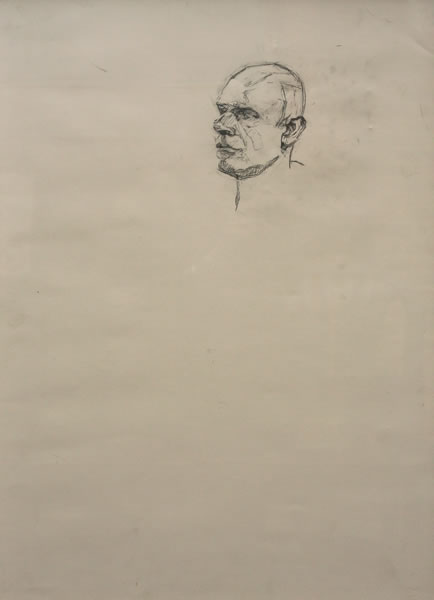


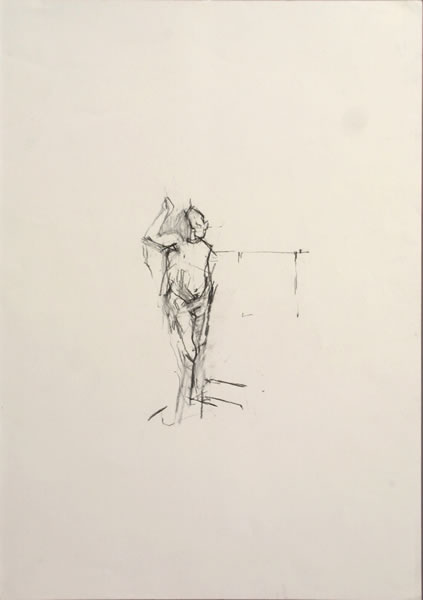


Wednesday, January 16, 2013
"The Hand Is An Interpreter, Not a Copyist..."

“There is a freemasonry... among figurative painters – and I mean the term in the metaphoric sense of a secret club as well as the sense of a guild of highly developed craftsmen, for great skill is required to observe and render the body. And it is both, observation as well as drafting. Over a lifetime of close watching one learns how muscles move and pull and place our bones into postures, and the ways that our bodies and faces can reveal our thoughts; the long, slow, laborious practice of making marks to represent what one sees isn’t as direct as the same thing might be if one takes a photograph, the mark-making also conveys what one senses and feels. The hand is an interpreter, not a copyist…”
(from a review of the exhibition, The Figure in Contemporary Art, Cypress College, curated by Thomas Butler, by Geoff Tuck on the blog Notes on Looking.) Click on the link to see work by Jerome Witkin, Domenic Cretara, Odd Nerdrum, Sigmund Abeles and others.
Saturday, March 31, 2012
Contemporary Genre
Genre (in Art): pictorial representations in any of various media that represent scenes or events from everyday life, such as markets, domestic settings, interiors, parties, inn scenes, and street scenes. - Wikipedia
"There are only two types of people in the world: artists, and subject matter." - Robert D'Arista
Ever since cavemen drew pictures of the hunt on their cave walls, we humans have taken a voyeuristic interest in art that reflects everyday realities. Holland in the 1600s was the golden age of genre, but the art form has appeared in every century and every culture. Even the artists who decorated the tombs of the pharaohs of ancient Egypt reveled in depictions of the every day actions and occupations of the common people.
In this album you can see work ranging from the Limbourg Brothers' early 15th century illuminated manuscript, Le Tres Riches Heures, to that of contemporary artists. Click on the slide show to see high resolution images.
For an earlier related post see: Genre Redux
For an earlier related post see: Genre Redux
Sunday, March 25, 2012
Tonal Games: the Mezza-Macchia and Notan
Spill your wine in Italy and you might hear your waiter utter the word, "macchia," which means stain, among other things. Consider for a moment an accidental stain from a spilled glass of red wine. The shape of the stain is essentially an abstract pattern, like a Rorsach blot test. In fact, this is what everything in nature looks like to your eye in that nano-second before your brain has "read" the pattern and figured out what, and where, everything is.
It's often said that part of an artist's training is learning to see, which is a stripped-down way of saying learning to bring conscious awareness, critical assessment, and emotional excitement to the perceptual process. From it's beginnings in optical sensation, to its culmination in emotion, association, and "meaning," the perceptual process is, for most people, a completely unconscious chain of events. For the artist, by contrast, nothing can be taken for granted. To paraphrase Henry James, the artist is someone on whom nothing is lost. The sense of sight is like the shell which conceals the pearl, or the rough ore which contains the gold. It's not enough to simply copy what you see. You have to dig for the treasure, and sift it out. How do you do that? The mezza-macchia is one strategy.
The mezza-macchia is a grand-child of the kind of radical chiaroscuro practiced by Caravaggio in the 17th century. Chiaroscuro, as we've discussed before, is the systematic behavior of light falling on form that Leonardo da Vinci, and other artists of the Renaissance, observed and codified into artistic practice. Equating tonal variations in nature to the value scale of art made it possible to render three-dimensional effects of light and shadow in powerful new ways.
So where does the term mezza-macchia come from, and what exactly is it? As early as the 16th century Vasari uses the word "macchia" to describe the rough, less refined chiaroscuro in Titian's late paintings, a quality that today we might call "painterly."* The word macchia gradually came to denote not only the essential tonal patterning of the subject but its effect, or its emotional impact. Mezza, in Italian, means half. So, mezza-macchia, as it came to be known and practiced in the art academies and ateliers of Italy, means a kind of condensed chiaroscuro that dispenses with some of the tones found in the typical gradations of classical tonal rendering.
The "Mezza-macchia" is to western European art what "Notan" is to eastern art, a study of light and dark. Like notan, the mezza-macchia study is limited to two or three values, the game being to reduce the chaos of visible reality to a structural essence. The resulting pattern, stripped of familiar details and identities, reveals abstract design forces that can potentially help or hinder composition. Especially in the work of older masters, particularly Poussin, for whom drawing was more a kind of visual thinking than a finished work, the reduction of the subject to simple masses of light and dark was an effective way to test and resolve issues of composition.
From the following examples you can see that the concept of the mezza-macchia has played a powerful role in shaping the teaching and practice of drawing and painting throughout the centuries and, in fact, continues on into the work of many contemporary artists for whom drawing is a self-sufficient art form, not just a means to an end.
*from Norma Broude's wonderful book on the Macchiaioli, a group of Italian artists who lived and worked in Tuscany in the 19th century.
It's often said that part of an artist's training is learning to see, which is a stripped-down way of saying learning to bring conscious awareness, critical assessment, and emotional excitement to the perceptual process. From it's beginnings in optical sensation, to its culmination in emotion, association, and "meaning," the perceptual process is, for most people, a completely unconscious chain of events. For the artist, by contrast, nothing can be taken for granted. To paraphrase Henry James, the artist is someone on whom nothing is lost. The sense of sight is like the shell which conceals the pearl, or the rough ore which contains the gold. It's not enough to simply copy what you see. You have to dig for the treasure, and sift it out. How do you do that? The mezza-macchia is one strategy.
The mezza-macchia is a grand-child of the kind of radical chiaroscuro practiced by Caravaggio in the 17th century. Chiaroscuro, as we've discussed before, is the systematic behavior of light falling on form that Leonardo da Vinci, and other artists of the Renaissance, observed and codified into artistic practice. Equating tonal variations in nature to the value scale of art made it possible to render three-dimensional effects of light and shadow in powerful new ways.
So where does the term mezza-macchia come from, and what exactly is it? As early as the 16th century Vasari uses the word "macchia" to describe the rough, less refined chiaroscuro in Titian's late paintings, a quality that today we might call "painterly."* The word macchia gradually came to denote not only the essential tonal patterning of the subject but its effect, or its emotional impact. Mezza, in Italian, means half. So, mezza-macchia, as it came to be known and practiced in the art academies and ateliers of Italy, means a kind of condensed chiaroscuro that dispenses with some of the tones found in the typical gradations of classical tonal rendering.
The "Mezza-macchia" is to western European art what "Notan" is to eastern art, a study of light and dark. Like notan, the mezza-macchia study is limited to two or three values, the game being to reduce the chaos of visible reality to a structural essence. The resulting pattern, stripped of familiar details and identities, reveals abstract design forces that can potentially help or hinder composition. Especially in the work of older masters, particularly Poussin, for whom drawing was more a kind of visual thinking than a finished work, the reduction of the subject to simple masses of light and dark was an effective way to test and resolve issues of composition.
From the following examples you can see that the concept of the mezza-macchia has played a powerful role in shaping the teaching and practice of drawing and painting throughout the centuries and, in fact, continues on into the work of many contemporary artists for whom drawing is a self-sufficient art form, not just a means to an end.
*from Norma Broude's wonderful book on the Macchiaioli, a group of Italian artists who lived and worked in Tuscany in the 19th century.
Double click on the slideshow to see full scale, high resolution images.
Tuesday, March 6, 2012
Working on Toned Grounds
Drawing on a toned ground is an old technique that has been knocking around in the history of drawing since the invention of paper. Unlike drawing on white paper, the half-tone ground allows the draftsman to compare values in the subject with the value of the ground, applying both darker and lighter values to develop the drawing.
Making a toned ground is simple. Traditional methods include staining the paper with tea, or laying a watercolor wash over the page. Acrylic paint can be used to tint gesso applied to paper or other surfaces. Toned papers and drawing supports of all sorts are available from art material suppliers. The range of materials that can be used on a toned ground are nearly infinite: charcoals, chalks, crayons, pastels, colored pencils, gouache and other paints...
In the album below are great examples of the toned ground approach, beginning with Michelangelo's teacher, Ghirlandaio, and ending with contemporary artists who are using the technique in new ways.

Making a toned ground is simple. Traditional methods include staining the paper with tea, or laying a watercolor wash over the page. Acrylic paint can be used to tint gesso applied to paper or other surfaces. Toned papers and drawing supports of all sorts are available from art material suppliers. The range of materials that can be used on a toned ground are nearly infinite: charcoals, chalks, crayons, pastels, colored pencils, gouache and other paints...
In the album below are great examples of the toned ground approach, beginning with Michelangelo's teacher, Ghirlandaio, and ending with contemporary artists who are using the technique in new ways.
Thursday, February 2, 2012
Interview with Alex Kanevsky at Painting Perceptions
Alex Kanevsky was born in Russia and grew up in Lithuania. He studied art there and also in Philadelphia where he now lives and works, teaching at the Pennsylvania Academy of Fine Art. In this recent interview, Kanevsky addresses a diverse range of topics, from the evolution of his work and his influences, to thoughts about the relationship of drawing and painting.
"Looking at a good drawing is like talking to a completely insane person, who nevertheless says some beautiful and profound things."
"I feel connected to what so many other artists did. We are not in vacuum. The dialog really exists. I don’t think it is some sort of linear progression that art historians are so fond of. It is more like a complex fascinating conversation with many people, dead and alive spanning several hundreds of years. It is a wonderful feeling to be able to talk with Rembrandt, and there is no other way to do that for me."

"Looking at a good drawing is like talking to a completely insane person, who nevertheless says some beautiful and profound things."
"I feel connected to what so many other artists did. We are not in vacuum. The dialog really exists. I don’t think it is some sort of linear progression that art historians are so fond of. It is more like a complex fascinating conversation with many people, dead and alive spanning several hundreds of years. It is a wonderful feeling to be able to talk with Rembrandt, and there is no other way to do that for me."
Friday, January 13, 2012
Learning From Poussin
The following is an article that first appeared in Modern Painters, by Richard Wollheim.
Learning From Poussin
Learning From Poussin
Wednesday, August 24, 2011
Frank Auerbach
This selection of drawings is courtesy of Facebook Friend, artist Picos Vazquez.
Frank Auerbach bio.


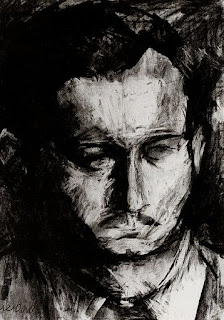


Frank Auerbach bio.


Monday, April 25, 2011
Narrative Figure Drawing
For most of the long history of art, drawings and paintings have been concerned with narrative, or telling a story. Because we are human, we naturally seek meaning in the circumstances of life, and therefore we relate strongly to pictures or images of the interactions of human figures. We read them like a text. Unlike a book that unfolds slowly, line by line, however, a drawing's impact, is immediate, visual, and sensuous. Bernard Berenson, in studying the great Italian figure artists of the past, observed that we seem to project ourselves bodily into those constructed spaces. In viewing images, visual sensation becomes tactile. Ideas enter not just through the mind, but through the physical body.
The difference between drawing from the model in the classroom/studio and beginning to work with the problem of narrative is like the difference between composing a song and an opera. The artist must wrestle with multiple, interconnected layers of meaning, and organize the parts and their relationship to the greater whole through the visual means of expression.
The most obvious way that artists convey narrative is through the poses and gestures and situations of their models. But, as in good fiction writing or poetry, it's not enough to simply insert an action or a situation. Whether the drawing will be just an illustration of an idea, "telling" us what's going, or a powerful visual statement that "shows" us, depends ultimately on the artist's organization of the visual form. Art was never made by subject matter or content alone.
Henri Matisse had a few things to say about that:
The problem of content or narrative does not negate the earlier and more fundamental concerns of figure drawing. Everything that is of concern to us in drawing from the model - gesture, proportion, construction, figure and ground, volume, mark, light and shadow, medium, the formal language - are still there and remain the fundamental problem in narrative figure work. Content has to be breathed into life through a visceral involvement with the making of FORM.
Following are some examples of the different Final Project Options. Old masters lead off followed by contrasts with contemporary artists who explore the issue of narrative in their work.
\
The difference between drawing from the model in the classroom/studio and beginning to work with the problem of narrative is like the difference between composing a song and an opera. The artist must wrestle with multiple, interconnected layers of meaning, and organize the parts and their relationship to the greater whole through the visual means of expression.
The most obvious way that artists convey narrative is through the poses and gestures and situations of their models. But, as in good fiction writing or poetry, it's not enough to simply insert an action or a situation. Whether the drawing will be just an illustration of an idea, "telling" us what's going, or a powerful visual statement that "shows" us, depends ultimately on the artist's organization of the visual form. Art was never made by subject matter or content alone.
Henri Matisse had a few things to say about that:
"Expression, for me, is not a matter of the passion mirrored on the human face or revealed by a violent gesture. When I paint a picture, its every detail is expressive."
"The whole arrangement of my picture is expressive. The place occupied by the figures or objects, the empty spaces around them, the proportions, everything plays a part." -Henri Matisse
The problem of content or narrative does not negate the earlier and more fundamental concerns of figure drawing. Everything that is of concern to us in drawing from the model - gesture, proportion, construction, figure and ground, volume, mark, light and shadow, medium, the formal language - are still there and remain the fundamental problem in narrative figure work. Content has to be breathed into life through a visceral involvement with the making of FORM.
Following are some examples of the different Final Project Options. Old masters lead off followed by contrasts with contemporary artists who explore the issue of narrative in their work.
NARRATIVE IMAGERY
 |
| Caravaggio, David and Goliath |
 |
| Artemisia Gentilleschi - Judith and Holofernes |
 |
| Georges De La Tour - The Musicians' Argument |
 |
| Renoir - The Boating Party |
 |
| Tim Kennedy |
 |
| Nicole McCormick Santiago |
PERSONIFICATION
 |
| Bronzino - Cupid, Venus, Time & Folly |
 |
| Detail |
 |
| Bartolomeo Manfredi - The Four Seasons |
 |
| Eugene Delacroix - Liberty Leading the People |
 |
| Asgar/Gabriel |
 |
| Kathe Kollwitz - Uprising |
 |
| Prudhon - Justice and Vengeance Pursuing Crime |
 | |
| Alfred Rethel- Nemesis |
 |
| Jack Beal - Prudence, Avarice, Lust, Anger, Justice |
ALLEGORY or MYTH
 |
| Caravaggio - Narcissus |
 |
| Velazquez - Bacchus |
 |
| Titian - Diana and Actaeon |
 |
| Titian - Diana and Actaeon |
 |
| Eric Fischl - Bad Boy |
 | |
| Rubens - The Three Graces |
 |
| Ottaviani (Contemporary) - The Three Graces |
 |
| Rubens - The Judgment of Paris |
 |
| Jack Levine - The Judgment of Paris |
 |
| Jack Levine - The Judgment of Paris |
PROTEST
 |
| Gericault - The Raft of the Medusa |
 |
| Goya - The Third of May |
 |
| Kathe Kollwitz - Outbreak |
 | |
| Kathe Kollwitz - Battlefield |
 |
| Kathe Kollwitz |
 |
| Carlton Fletcher |
NARRATIVE SPACES
 |
| Antonio Lopez Garcia |
 |
| Antonio Lopez Garcia |
Subscribe to:
Posts (Atom)